Orizzonte
Bluewater variant available
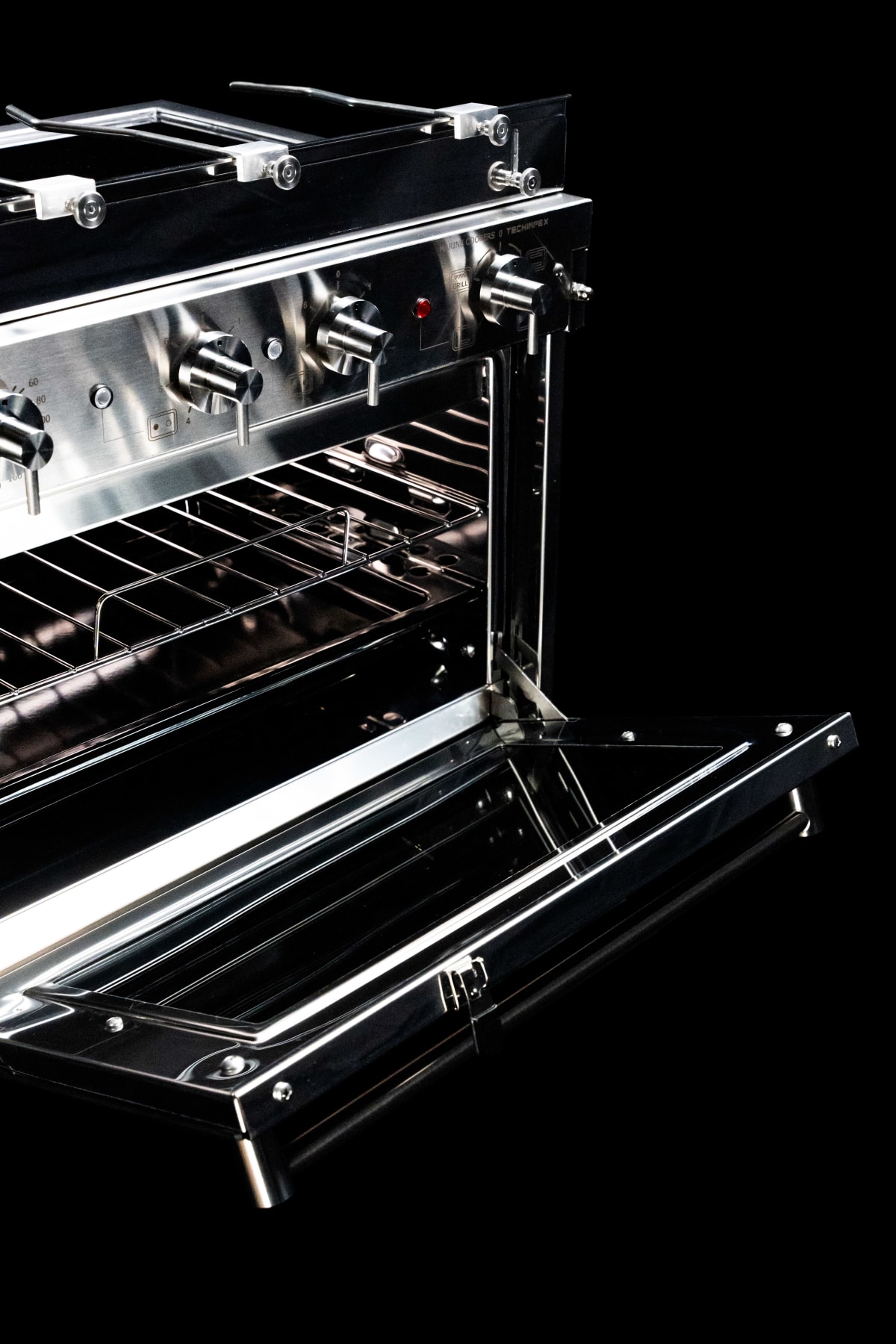
The largest of the three
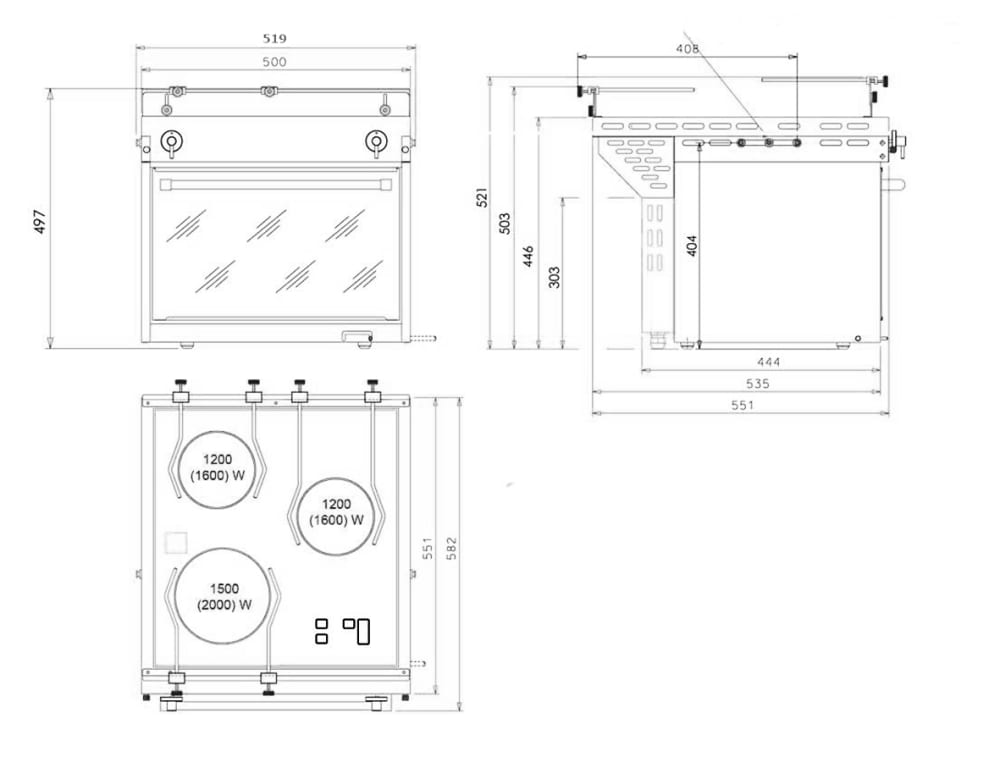
Hob1 – 5.2 kW
Oven1.6 kW
Total draw1.75 – 6.8 kW
W×D×H52.5 × 55 × 50h cm

Marine induction · Electric cookers · Bluewater variants
Gimballed marine induction cookers with a full oven, and a wider electric range behind them. Handmade in stainless steel in Conegliano, in the mainland district behind Venice.
Bluewaterevery model is also built in an ocean-passage variant
We build a full range of gimballed marine induction cookers with an oven, and built-in induction hobs from one to four zones, for sailing and motor yachts. Induction is one of the technologies we offer, not the whole of it: the range is a complete one of marine electric cookers, radiant glass-ceramic included, along with cooking systems that are exclusive to us. Made by hand in 304 and 316 stainless steel, and made to measure when the boat asks for it. Every model can also be built in a Bluewater variant, for ocean passages.
Already know what you are looking for? Go to the main website
The problem
An off-the-shelf hob, domestic or marine, is often the inexpensive answer, though not always, since some cost a great deal. Either way, price is the wrong thing to look at. Hobs differ from one another far more than they appear to, because what is underneath them can work in completely different ways, and that is what has to be looked into: some boats and some electrical systems can carry a given hob, and others cannot. There is no one solution that suits everyone. There are several technologies, and we do our best to develop all of them, because a boat asks three things of a hob that a kitchen never does.
Movement
The cooker swings on gimbals so the pan holds level while the hull works, and the oven door stays shut while it does.
Power
Batteries, solar, a generator, shore power: whatever the boat has, it is shared with the fridge, the air conditioning, the lights and everything else aboard that needs electricity. A hob that asks for more than the system can spare gets used once. And power at sea does not behave the way it does at home: an inverter or a generator does not always deliver it the way a hob would like, and not every hob draws it in a way the system is happy to give.
Salt
Doors, seals, hinges and pan holders fail first. We build them in 304 and 316 steel, and we keep them available.
There is a second half to this, and it gets said far less often. If an off-the-shelf domestic hob is a limiting way to equip a boat, then an off-the-shelf marine cooker is limiting in the same way. A catalogue of three or four models, take it or leave it, is still a catalogue. People cook aboard in very different ways, on very different electrical systems, and we would rather offer technologies than a shortlist: induction in several forms, radiant glass-ceramic, ovens in different configurations, a microwave for the owners who want one, and cooking systems that are exclusive to us. Replacing gas with electricity is worth doing properly, and properly is rarely one page of a catalogue.

Bluewater · Ocean passages
Coastal cruising and an ocean passage are not the same boat
Weeks at sea change every decision. That is why every cooker on this page exists in a second version, built for it.
The range
Tap any of the four below to open that part of the main site.
Three examples from a much wider range
Three induction cookers, shown here as examples. This page is mainly about induction, which is why all three are induction models, even though it also covers the other ways of cooking electrically. They are three of many: the range holds other induction models and other technologies besides, and no page or catalogue has ever held all of it. The figure that matters aboard is the total draw: it is adjustable, so the cooker runs inside whatever the bank can give that day. Click here to see more models on the main website, or click here to contact us for anything you cannot find there.
Bluewater variant available
The largest of the three

Bluewater variant available
Shallower, where depth is tight
Bluewater variant available
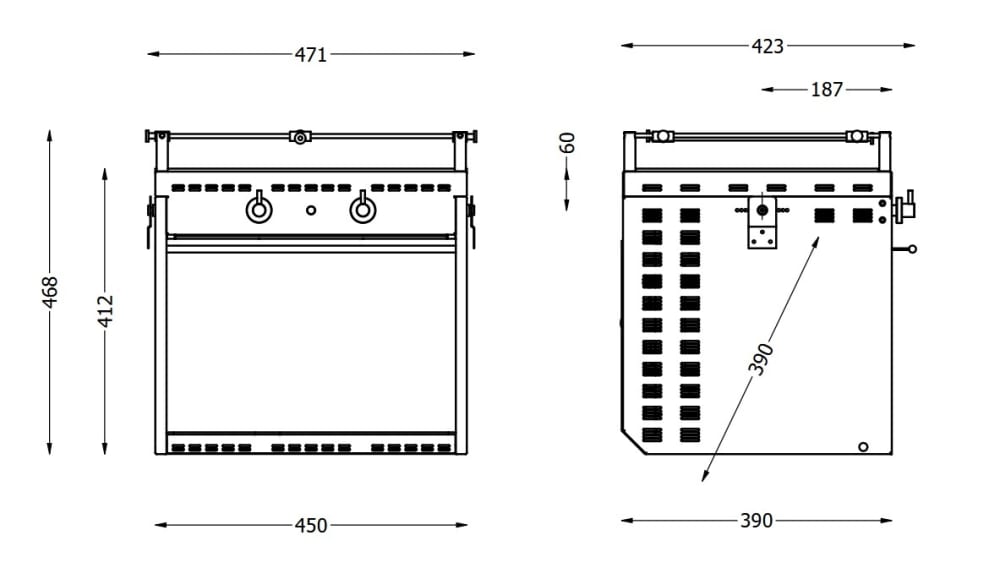
The smallest footprint
These three are a sample. The range runs from single-zone hobs up to built-in cooktops with one to four zones, and gimballed cookers with a full oven in several widths and heights, so a boat of almost any size has a unit that fits it, with radiant glass-ceramic and our own cooking systems alongside the induction models. Click here to see a wider selection on the main website, though not even that is the whole range. For anything beyond what is published there, click here to tell us about the boat and ask.
And any of them can be made to measure. We build to order around a single boat, working from the yard's drawings or from the owner's own, when someone is building or refitting to their own ideas: different widths, different finishes, different controls. The more complicated projects are handled by the factory itself, on its own or alongside our distributors, so nobody is left to work it out on their own. Full dimensions and datasheets for every standard model are on the main site.
Gimbals, set to the boat
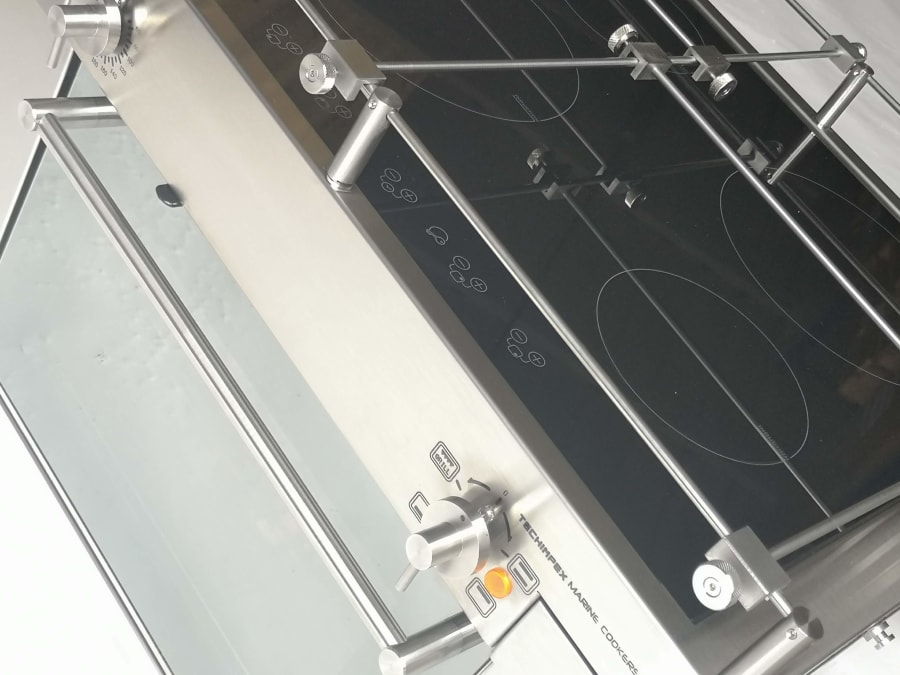
Every gimballed boat cooker swings. Whether it swings well is another matter. A cooker that is hung but not balanced sits slightly off true, lags behind the boat, and snatches at the end of its travel when a full pan is on the hob. On a long tack you hear it before you see it.
Our cookers hang on pivot pins and support brackets with an exclusive installation system, so the cooker is set perfectly horizontal in the boat it is going into, not in our workshop and not in theory. It is the difference between an appliance that has been fitted and one that has been set up.
It matters more on a sailboat than anywhere else. Replace a gas stove with an electric one and the weight in that part of the boat changes; add a battery bank for induction and the boat's trim changes with it. A cooker that can be brought back to true is a cooker that still cooks properly in five years.
Power on board
The usual objection to induction on a boat is power, and it is a fair one. Most marine induction cookers ask you to rebuild the electrical system first, a bigger bank and a bigger inverter, before you can cook at all.
We fit different induction hobs to the same cooker, chosen against the supply the boat actually has. Some of our hobs draw approximately one kilowatt in total. What that figure means for a particular boat, and what advantages may follow from it, though not necessarily will, is something to be looked into case by case rather than assumed.
Induction hobs are also far less alike than they look. Two of them can carry the same rating and behave completely differently once they are running on a boat: some draw very little, some cycle heavily, switching the element on and off at full power instead of holding a steady level, and some do a great deal less of it. Then there is how finely the power can actually be regulated, and at what price that fine control becomes available at all. We use several technologies, including systems that are exclusive to us, and we pick between them against the boat rather than against a spec sheet. It is a question worth putting to any hob, ours included.
There is no single right answer here: there are several variants, and the one that suits a 40-foot sailboat at anchor is not the one that suits a motor yacht on shore power. Tell our engineers what is on board and they will tell you which hob fits it.
The oven
Cooking properly is not a luxury we were willing to give up at sea. It is the reason the oven, in our range, is not the part that was simplified to make the numbers work.
The oven is also the demanding one. A hob runs in bursts; an oven stays on, often for the better part of an hour, and it is the appliance most likely to tire the system that feeds it. That is where we concentrated the work.
The result is not one oven but several, in different configurations, with heating elements calibrated to ask as little as possible of the boat's electrical system. Which one belongs on a given boat depends on what that boat can supply, so our engineers will go through it with you rather than sell you a single answer.
Efficiency, though, does not automatically rhyme with cooking well, and an oven that is frugal but cooks badly has only done half the job. A cooker exists to cook. We are Italian, and we are fixated on eating properly, and we suspect that much is known everywhere. We work in the Inox Valley, one of the most important districts in Europe for professional cooking equipment. Building an oven that really cooks is a far more complicated thing than building one that merely heats, and it is the part we were least willing to compromise. In the end we build these cookers for people like ourselves, and Italians are demanding customers.
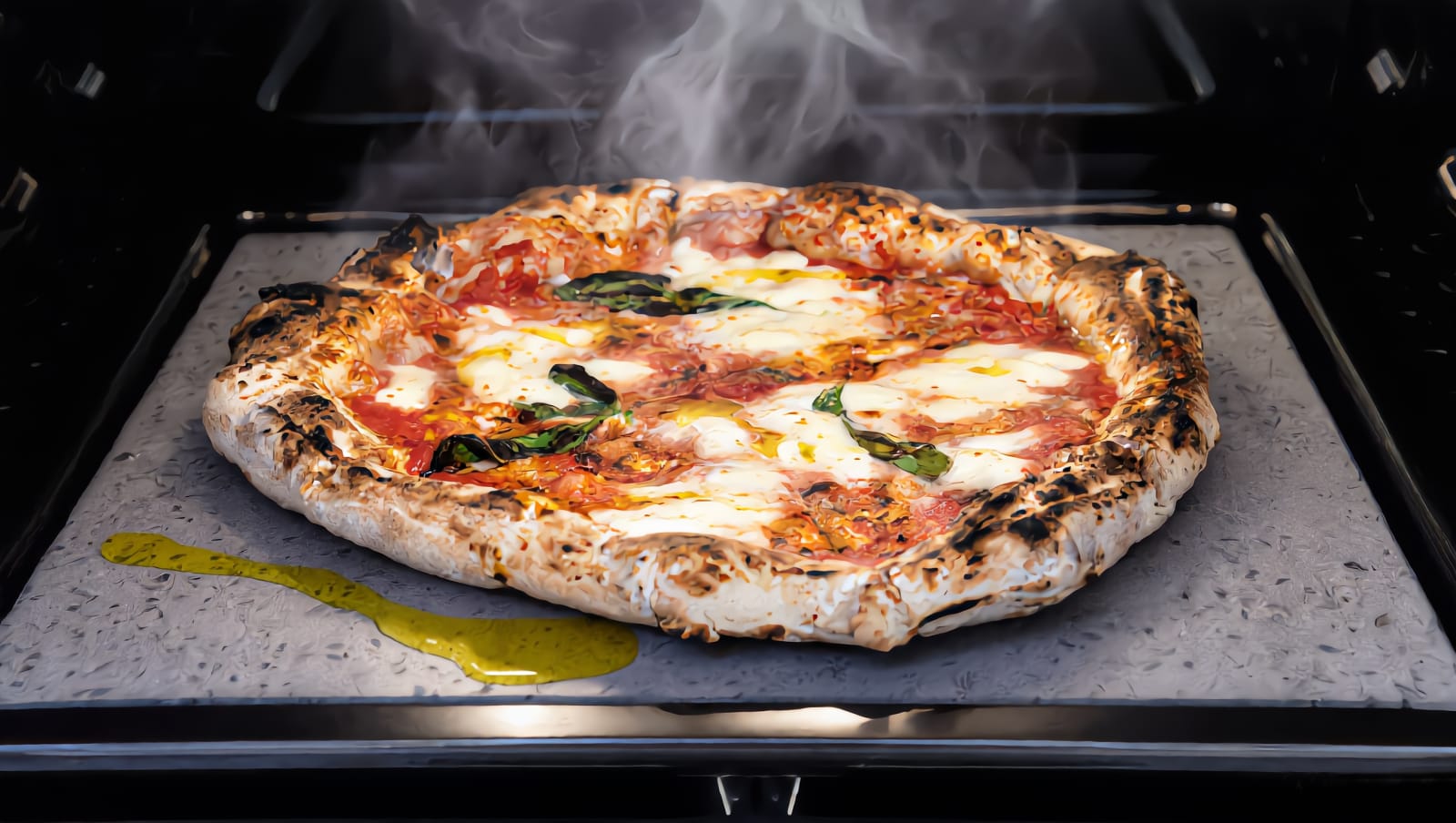
Three things get confused here, and they are not the same thing at all: efficiency, speed and how well an oven actually cooks. An oven can reach temperature quickly. Several of ours do, and it is a useful quality. But getting hot fast says nothing about the result that comes out an hour later: it is a sign of speed, not of cooking, and not really of efficiency either. In the same way, an oven can be frugal and still cook only certain things well. Most efficient ovens do exactly that. They are excellent at part of the repertoire and ordinary at the rest, which is fine if it happens to be the part you cook, and disappointing if it is not.
Efficiency does not come only from the cooking technology inside the oven either. It begins with the insulation, and a great deal of it rests on the door. We use several kinds of insulation rather than one, and the doors across the range are built in genuinely different ways: the glass, how many panes of it, the hinges, which are not all alike, and the seals. Some of our ovens carry solid stainless steel hinges, and there is a reason for that. The seal matters as much as any of it, because a door that is beautifully made and closes only approximately has undone its own work. How the seal behaves in use is one of the things we spend time getting right. Which door and which insulation belong on a given cooker is, once again, a question of what an owner wants and what they are prepared to spend.
An oven that is efficient and cooks everything well is a harder thing to build, and it costs more than one that is efficient and cooks a narrower range well. Both are legitimate answers. Which is why there is a range rather than a model: what it comes down to is what an owner actually cooks aboard, and what they are prepared to spend. Nobody should assume that efficient and good are the same word.
That said, the recipes you cook at home are not always the ones that matter a thousand miles from anywhere. Sometimes what counts is cooking fast, or cooking frugally. The two are not in conflict: across the range, and across its variants, there are ovens meant to cook well and ovens meant to cook economically, and some that do a fair amount of both. A microwave is one of the variants we offer, for the owners who want one. It is also the plainest illustration of the point above: nothing in a boat heats faster than a microwave, and nobody has ever called it the best way to cook. Speed and quality are simply not the same measurement. It is unbeatable for heating liquids and reheating a quick plate, and unsuited to a great deal else. Others will not hear of it. Which is rather the point: what suits an owner depends on how they actually cook aboard, and on whether they are after speed, economy or the quality of the result. It is why we have never offered a single technology.
We took the same approach to the hobs, with cooking systems of our own design and the same concern for what the supply can carry. None of it arrived at once. We have been building electric marine cookers for a very long time, and induction for more than ten years, and the range that came out of it is a wide one, developed with the shipyards that fit our cookers as original equipment and with owners sailing in every part of the world. Each generation was shaped by what came back from boats that had been out a long time: ocean passages, an Atlantic crossing, weeks between marinas, where the cooker works every day on what the boat can generate.
The other way off gas
We believed in electric cooking at sea from the moment it became possible, and we have never stopped building radiant glass-ceramic hobs alongside the induction range. Our engineers have been making them since the early 2000s, for European yards, and we still offer both technologies in several configurations and made to measure. That is deliberate: neither one is simply better than the other.
What radiant costs you. The plate has to reach around 500 °C to cook what sits on it, so the surface gets genuinely hot, while induction works at far lower surface temperatures. Radiant also tends to draw more.
What radiant gives you. It is a robust technology with very little electronics controlling it, which is why some owners ask for glass-ceramic and nothing else, and why we still hear from customers whose radiant cookers have been aboard for a very long time. Ours are built to professional standards: the same district gives us access to construction techniques that are hard to find elsewhere, and the radiant elements we fit are made by partners who build them for professional kitchens.
And one thing rarely said about induction. Its efficiency is real, but it is not identical from pan to pan. This is not the familiar point that induction needs a ferritic base, which is obvious enough. It is that among pans that all have a ferritic base, some perform noticeably better than others. The hob is only half of it.
There is also a third way. Some of our hobs use a cooking technology that is exclusive to us, developed in-house together with our partners from the professional catering world, and it draws less than either induction or radiant. It is not a simple system to explain in a paragraph, and our engineers would rather talk it through than summarise it here.
All of which matters most when the electrical system is the obstacle. Leaving gas behind does not have to mean rebuilding the boat's electrics at a cost that makes the whole idea collapse. Often there is a solution that works with what is already installed. A high-performance glass-ceramic hob, or one of our own systems, will take a boat off gas on a supply that induction would find tight.
It is why the range is as wide as it is. At one end there are cookers meant to be affordable; at the other, uncompromising cookers for boats where nothing is being economised. We can build across that span because cookers, hobs and ovens are all we build, and we build them in volume as well as one at a time, and the series production is what keeps the accessible end of the range genuinely accessible. Tell us the boat, the electrical system and the budget, and we will tell you which part of the range you are actually looking at.
How we work
The company is called Techimpex Marine Cookers, and that is not a slogan: it is the company name, the brand and the logo, and it says exactly what we make. Not furniture, not fit-outs, but the cooking appliance itself. Cookers, hobs and ovens for boats, and nothing else, for three generations.
Built by hand in Conegliano, in the mainland district behind Venice: one of the most important in Europe for professional cooking equipment. Cookers, hobs and ovens, and nothing else.
Marine-grade throughout, not only where it shows.
Exploded views, manuals and parts for models sold long ago. A marine stove is refitted, not replaced.
Every model can be built to order around a single boat, from the yard's drawings or the owner's own: widths, finishes, controls.
A Bluewater variant of every model: oversized gimbals and grates, reinforced structures, heavier door locks. Weeks at sea change every decision.
We sell worldwide through a global network of distributors, and ship direct where there is no dealer nearby. Tell us where the boat is and we will point you to the right one.
Working with shipyards
Get in touch
Country and city are required: the right distributor depends on where you are, and so does the quotation. If the boat is going offshore, say so in the message and we will quote the Bluewater variant.
Click the drawing to zoom · scroll to zoom · Esc to close